Why Do Bahrainis Mock the News?
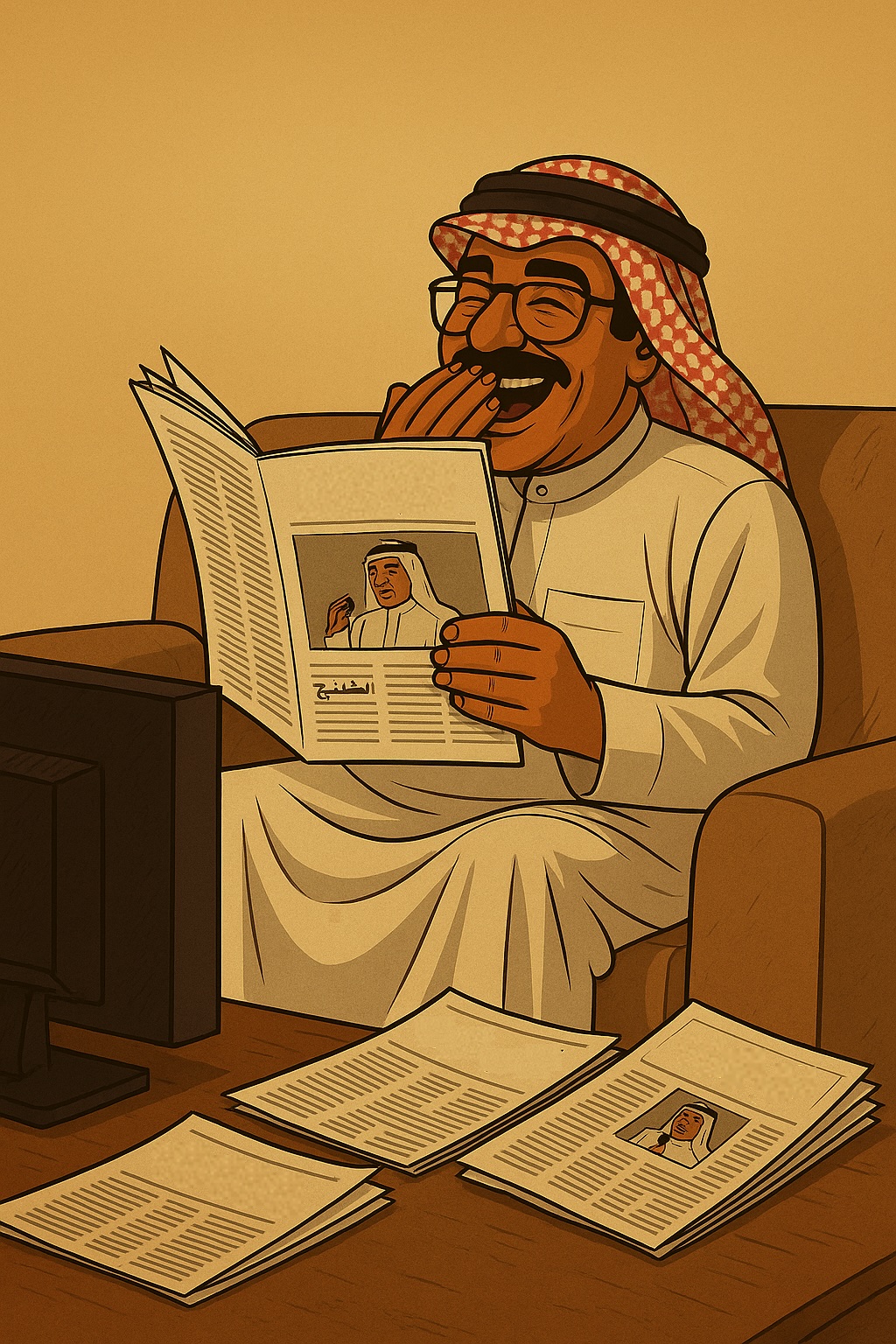
Bahrain Press Association (6 November 2025): Over the span of two decades, Bahraini journalism has undergone a harsh transition—from the peak of its print influence to a sharp decline in public trust.
In the early 2000s, daily newspapers held a prominent position: subscriptions arrived at doorsteps every morning, some issues sold out, and vendors stood at traffic lights and in small grocery shops (“bardats”). This era coincided with a period described as political openness and expanded freedom of opinion and expression after the reform project, leading to the emergence of newspapers like Al-Wasat and Al-Waqt, which forced older newspapers to raise their editorial ceiling.
This trajectory quickly collided with a political and security wave after 2011, which reshaped the entire media environment. Then came the decision to shut down Al-Wasat on June 4, 2017, closing the last significant independent outlet and marking the end of an era of public debate through local press as Bahrainis had known it.
This institutional shift in journalism coincided with a behavioral shift in news consumption. Before 2011, online forums and blogs filled part of the gap that traditional newspapers could not reach. Then conversation quickly moved to social networks—especially Twitter, which became the primary political platform—while instant messaging apps carried waves of “breaking news” and leaks. Readers no longer sought the comment section beneath a newspaper article, but instead sought personal visibility, a public identity, and direct interaction that offered something akin to “social recognition.” This was supported by Bahrain becoming one of the Gulf’s most internet-penetrated countries.
But the digital environment that hosted this discussion was not neutral. After 2011, Bahrain entered a prolonged phase of restricting the public sphere, including arrests, prosecutions, and harsh sentences against journalists and activists for expressing opinions. These severe prosecutions and expanded criminalization produced high levels of self-censorship in newspapers and among activists alike. Prison sentences for journalists, politicians, and activists became a “memory of risk” for users, and in the words of Amnesty International, “serious speech in Bahrain can be costly.”
This was accompanied by a legal and technical reshaping of the internet and media structure. Legally, the highly strict Press, Printing, and Publishing Law (Decree-Law No. 47 of 2002) remained in force, while the Cybercrime Law (No. 60 of 2014) and the State Documents and Information Protection Law (No. 16 of 2014) expanded criminalization in the digital space, limiting the margin of peaceful expression and drawing human-rights criticism.
Internationally, Freedom House classifies Bahrain as a “restricted” country online, with website blocks, content removals, and criminal prosecution for online expression. The U.S. State Department’s annual human rights reports also point to ongoing restrictions on media and free expression. Human Rights Watch described this cumulative legal and practical reality as making the news environment resemble a “reformatted official statement” rather than a journalistic product open to accountability and debate.
This is exactly where mockery is born.
When the function of a newspaper shifts from being an independent mediator between society and the state to a public relations channel that rebroadcasts a single narrative, the reception of news changes.
Bahrainis read the news as an official narrative, not as information inviting discussion. And because the cost of objecting or responding directly can mean many years in prison, Bahrainis choose a less costly method: mockery, jokes, memes, and hints.
This style serves several functions, the most important of which is psychological relief and sending a subtle message of skepticism toward the credibility of the news without engaging in actions that could be criminalized or politically interpreted. And with algorithms that favor brevity, drama, and emotion, mockery is rewarded and spreads faster than calm analysis. It becomes the “language of debate” online when independent intermediaries vanish and spaces for serious commentary shrink.
Mocking the news in Bahrain is not an inherent hostility toward news itself, but the product of intertwined circumstances.
The first factor is loss of trust in newspapers, which operate without government accountability and without plurality of sources. The second is risk: the state’s apparatuses will treat serious commentary as a political position that may cost its author dearly. The third is the nature of the content: what is presented to citizens is a single, non-verifiable narrative that cannot be questioned or critiqued—rendering it ripe for humor and satirical deconstruction.
Between 2002 and 2011, the press in Bahrain acted as a “mediator” that conveyed public concerns, highlighted institutional and administrative flaws, and played an active role between society and the state within a reformist horizon. As this role declined, the demand for serious discussion also declined. In other words: when the news loses its persuasive function, the “economy of disbelief” prevails, and mockery flourishes.
Restoring a healthy relationship between society and the news requires the state to end practices that suppress freedoms, and to review the legal provisions used to criminalize peaceful expression—within the Press Law, the Cybercrime Law, the Terrorism Law, and other security-based texts applied to freedom-of-expression cases. It also requires providing professional guarantees inside and outside newsrooms that enable journalists and activists to produce research-based journalism, investigations, and responses to government statements—journalism that can question government narratives in politics, economics, and public services.
Bahrainis’ mockery of government news is a natural result of a society that wants to express its opinion without paying a high price, in an environment that restricts serious speech and redefines news as official statements from state ministries and institutions.
Fixing this environment is not achieved by improving visual presentation alone, but by rebuilding the conditions of trust: balanced laws, institutional accountability, transparency of information, and independent professional platforms. When these conditions are met, Bahraini journalism regains its freedom, and news regains its original function: to persuade with information, not to serve as material for sarcasm and mockery.