Is Print Journalism in Bahrain Living Its Final Days?
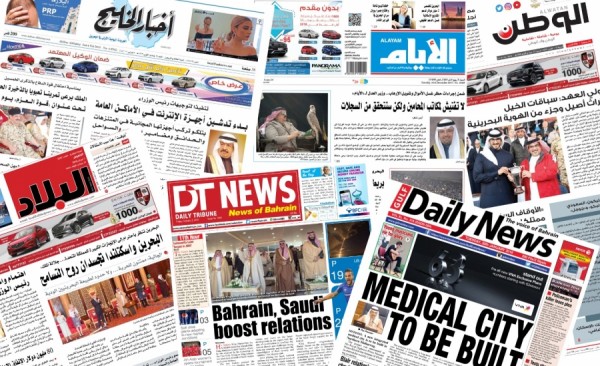
Bahrain Press Association, February 27, 2026: Print journalism in Bahrain is experiencing a deep crisis that is no longer hidden from observers and those concerned with media affairs. This crisis has multiple dimensions and causes, yet its outcome appears nearly the same: a press sector wavering between the loss of influence and relevance on one hand, and commercial extinction on the other. Indirect government support — along with newspaper owners viewing financial spending as part of their own political promotion — remains the primary factor keeping these publications alive.
Over the course of an entire week, printed editions of Bahrain’s four local newspapers were monitored and their news content, quality, and opinion articles analyzed. The findings were alarming and concerning. The majority of published material falls within the category of official statements and government announcements issued through formal channels, including reports on meetings of the Council of Representatives and the Shura Council and their committees, routine decisions, parliamentary questions accompanied by ready-made government responses, and pre-distributed agendas provided to media institutions.
Notably, some newspapers attribute these ready-made materials to their own editors after making minor adjustments, while others publish them without bylines altogether. Exclusive reporting — even at its most basic level in terms of importance or investigative value — rarely exceeds two stories per issue. On some days, two newspapers published only a single signed report produced by one of their journalists. These indicators reflect not only a decline in journalistic production but also a deeper crisis concerning journalism’s very function and role within the public sphere.
Roots of the Crisis: Complex Factors
The crisis facing journalism in Bahrain can be traced to accumulated political, professional, and technological developments, most notably:
First: The Closure of Al-Wasat Newspaper and Its Aftermath
In 2017, Al-Wasat, the country’s only independent newspaper and one known for maintaining a broader critical editorial line, was shut down. Although the Ministry of Information Affairs’ statement at the time did not present the closure as permanent, authorities later refused to allow the newspaper to resume publication, effectively settling the matter.
The closure marked a turning point in Bahrain’s media environment. Press freedoms noticeably declined, and self-censorship expanded within remaining media institutions, which — due to political alignments and regulatory restrictions — increasingly came to resemble government-aligned outlets rather than independent press organizations. Newspapers gradually distanced themselves from issues affecting citizens’ daily lives or exposing shortcomings in public policies, instead becoming nearly identical platforms in both content and headlines, often with minimal editorial effort.
The Bahrain Press Association has also received numerous complaints from columnists indicating that the margin of press freedom has become extremely narrow, leaving writers unable to criticize government ministries and service institutions, let alone address sensitive political or economic issues.
Second: Digital Transformation and the Challenge of Online Platforms
In Bahrain, as elsewhere, digital transformation represents one of the greatest challenges facing print journalism. Al-Wasat had been among the earliest Bahraini newspapers to invest seriously in digital presence, offering visual content and rapid event coverage where timeliness was essential, including breaking news.
By contrast, other newspapers transitioned to digital platforms relatively late, often without a clear editorial vision distinguishing online content from print editions. Despite some gradual development, newspapers have yet to meaningfully invest in data journalism or produce unique digital content suited to evolving consumption patterns or addressing key political issues discussed by citizens. Over time, these outlets lost competitiveness to more flexible and widely distributed digital news platforms.
Third: Social Media and “News Services”
The rapid expansion of social media has led to the emergence of a new category of media actors locally known as “news services.” These accounts publish short, fast-paced news items designed to generate engagement while avoiding politically sensitive topics.
Funded primarily through advertising and commercial sponsorships, such platforms require neither complex editorial structures nor professional journalistic staff. Small teams capable of crafting attention-grabbing headlines and quick visual content are sufficient. This model has drawn a significant portion of newspaper audiences, particularly through locally focused accounts covering village and community affairs or specialized areas such as sports.
Although these platforms do not fulfill journalism’s deeper professional role, they have successfully occupied an influential position in daily media consumption due to speed and proximity to audiences’ immediate interests.
Fourth: Societal Transformations
Globally, journalism faces changing media consumption habits among younger generations, particularly Generation Z (born 1997–2012), which grew up in dense digital environments shaped by short videos and fast content formats. This generation favors visual media over lengthy written analysis and demonstrates lower engagement with long-form analytical material.
This shift is not unique to Bahrain; it is reflected in declining viewership of traditional news channels and falling print circulation worldwide. However, its impact in Bahrain appears amplified by limited locally engaging content and the absence of serious efforts to reinvent journalism using formats and language appealing to younger audiences.
Solutions Are Possible
The options available to local newspapers appear limited. Continuing the current model based largely on recycling official statements places these publications on a clear path of decline. International experiences demonstrate that digital transformation has become an existential and unavoidable trajectory.
Such transformation requires a comprehensive rebuilding of both editorial and economic models through:
- Gradually reducing reliance on print editions, ultimately discontinuing them in favor of advanced digital platforms.
- Improving journalistic content — particularly by expanding political coverage and focusing on investigative reporting and human-interest stories reflecting the daily challenges faced by Bahrainis.
- Offering added digital services such as video content, podcasts, digital talk programs, and daily analytical video briefings.
- Seriously exploring flexible subscription models that reflect local purchasing power while convincing readers that paid content delivers genuine informational value worth subscribing to.
- Investing in training journalists in digital journalism tools and modern storytelling techniques.