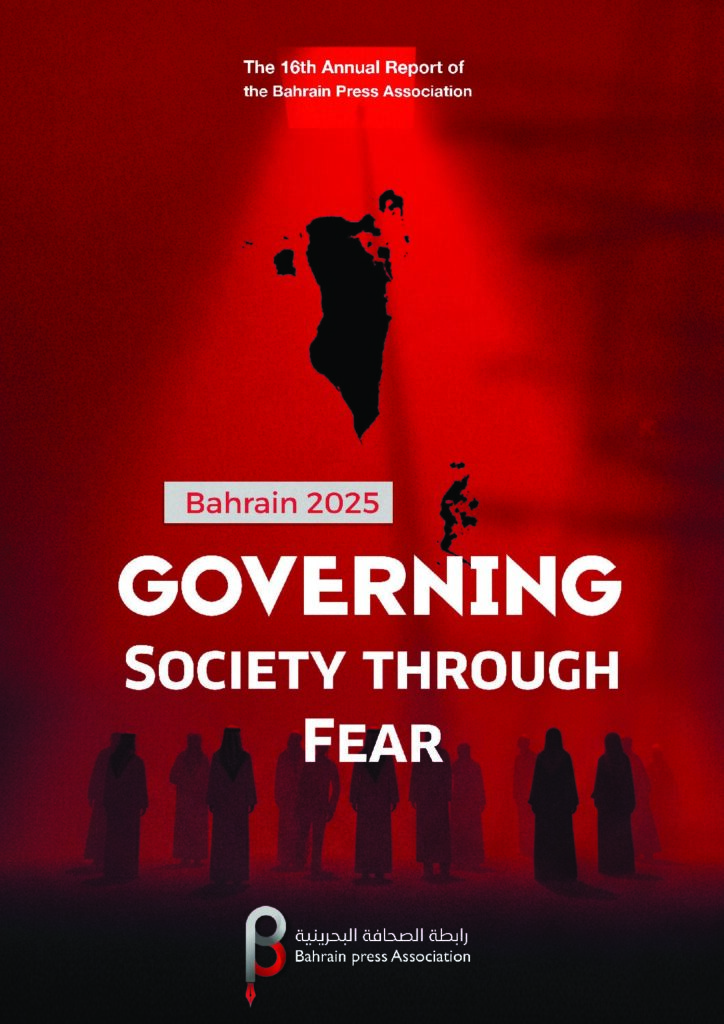
The Bahrain Press Association publishes its sixteen annual report: Bahrain 2025: Governing Society through Fear
London, United Kingdom – 3 May 2026: On the occasion of World Press Freedom Day 2026, the Bahrain Press Association (BPA) is issuing its annual report on the state of press freedom and freedom of opinion and expression in Bahrain during 2025, entitled: “Bahrain 2025: Governing Society through Fear“.
This title reflects a major shift in the nature of governing the public sphere in Bahrain, where restricting freedom of opinion and expression has become an integrated system for controlling society through fear. This system is based on restrictive legislation, preventive deterrence, pre-emptive criminalization, and expanded legal tools for regulating opinion and expression.
The report documents roughly 74 cases of violations in 2025 against journalists, writers, activists, and citizens. These violations ranged from arrests and interrogations to judicial rulings and bans on media coverage. This was also accompanied by widespread religious restrictions during the Ashura season and a systematic targeting of expressions critical of government performance or supportive of certain regional issues. In addition, the report recorded over 60 freedom of opinion cases that amounted to arrests or interrogations, and 10 cases that led to judicial rulings, indicating a clear expansion in the scope of punishment and its transformation from an exceptional deterrent to a daily governance policy over the public sphere. Consequently, the total violations documented by the Association since the outbreak of the February 2011 protests until the end of 2025 rises to over 2,074 violations, in a cumulative trajectory that confirms that the crisis in Bahrain has become deeply rooted in the relationship between the authorities and freedom of expression and the press.
The report indicates that the year 2025 marked a turning point with the enactment of the new Press Law, not as a legislative breakthrough, but as a legal framework that legitimizes the targeting of journalistic work and electronic media. As a result, journalists and media institutions are kept under constant threat of prosecution and closure through vague provisions that practically refer to the Penal Code, and subject the digital space to strict administrative oversight.
The report also underscores the use of the judiciary to pursue public opinion with repeated charges such as “misuse of social media,” “spreading false news,” “undermining the social fabric,” and “violating public morals.” Furthermore, the direct targeting of international journalism is a message that censorship is no longer merely a domestic policy but extends to foreign coverage.
The head of the Bahrain Press Association, Adel Marzooq, said: “The report reveals a profound shift in the way the public sphere is managed. Fear has evolved into a daily instrument for regulating behavior, opinion, and expression. The state views freedom of opinion and expression as a threat to stability and security.” He added, “Statistically, the rate of serious violations has declined, and the reason is that the tools of intimidation and control used by the state are effective. Civil society activists, including politicians, journalists, and human rights activists inside Bahrain, refrain from speaking out or expressing their positions for fear of triggering the harsh punitive mechanisms, and this is what the state ultimately aims for.”
Marzooq further added that Marzooq added: “Reform begins with the state’s conviction of the necessity for change, through reviewing the legal frameworks regulating journalistic work and political and media freedoms, in a way that ensures the protection of freedom of expression and restores the role of the press as a space for oversight and as a partner to the state in ensuring the country’s security and stability. We also emphasize that restoring citizenship to journalists whose citizenships were revoked represents a fundamental step and a practical test of the state’s seriousness in opening up and moving towards the long-awaited national reconciliation.”
The report “Bahrain 2025: Governing Society through Fear” documented a striking escalation in the politicization of regional issues within the Bahraini public sphere, where any expression exceeding the permissible symbolic line was targeted through summonses, forced pledges, and trials. In the same context, the year witnessed a new peak in the pursuing of the Shia community on religious grounds, with the Ashura season turning into a security confrontation arena that included the removal of religious symbols, arrests, and trials.
The report also highlights the continuing expansion of the role of the Cybercrime Directorate, functioning simultaneously as both opinion and morality police, employing a policy of summons and threats through coercive pledges and the deletion of critical content.
Recommendations
In light of what the Bahrain Press Association documented during 2025 regarding the transformation of fear into a general tool for managing political, media, religious, and social spheres, the Association emphasizes that addressing the crisis requires a radical shift in the state’s relationship with freedom of expression and journalism, and thus recommends the following:
- The immediate and unconditional release of all civil society activists who have been detained or sentenced because of their opinions or peaceful activities, and ending all forms of arbitrary summons and coercive pledges imposed outside the framework of the law.
- Repealing or suspending the application of vague legal provisions used to criminalize opinion, foremost among them the articles on “false news,” “misuse of social media,” and “undermining the social fabric,” until they are brought into line with international standards.
- Restoring Bahraini citizenship to all journalists, writers, and political activists whose citizenship was revoked for political reasons, as a fundamental step towards any serious national reconciliation and a true test of the credibility of reform.
- Freezing the current form of the Press Law, halting the application of its restrictive articles, and opening a transparent dialogue with journalists, independent institutions, and civil society organizations to draft a modern media law that protects press freedom.
- Ending the state and influential figures’ monopoly on the media and allowing the establishment of editorially independent media outlets, and guaranteeing their right to coverage without security or administrative interference.
- Protecting digital media as the last remaining space for public expression and halting the policy of compulsory licensing and administrative closure of websites and online platforms.
- Redefining the powers of the Cybercrime Directorate and limiting them to actual technical crimes, preventing their use as a tool for monitoring opinions and political, religious, and social content, while subjecting its work to independent judicial oversight.
- Stop using the judiciary as a tool for political deterrence, and ensuring its independence and preventing its use as a means to silence criticism related to public affairs.
- A call for a comprehensive review of the philosophy of “security” in state governance by transitioning from a logic of deterrence and fear to a logic of trust and rights, considering freedom of expression as a component of stability rather than a threat to it.
- Guaranteeing the freedom to practice religious rituals and ending security measures during religious occasions, especially Ashura, in a manner that preserves citizens’ right to peaceful religious expression.
- Guaranteeing the right to demonstrate and assemble peacefully without selective restrictions or interference, and ending the policy of controlling protests through prohibition and conditional permits.
- Inviting the United Nations Special Rapporteur on the Promotion and Protection of the Right to Freedom of Opinion and Expression to schedule an urgent visit to Bahrain and to present a public report on the state of media and digital freedoms.
- Urging Bahrain’s friendly countries to raise the issue of freedom of expression and the importance of expanding press freedoms in the country within their political and diplomatic dialogues.
- Urging international organizations concerned with press freedom to enhance long-term monitoring and encourage exile journalism and digital alternatives to counter the internally imposed silence, ensuring that independent voices reach the outside world.
The continued governance of society through fear only exacerbates the deadlock and deepens the gap between the state and the society. Only by respecting freedom of expression, opening the public sphere, and protecting independent journalism can Bahrain be placed on a more balanced and sustainable political and media path.
The Bahrain Press Association extends its sincere gratitude to all who contributed to the preparation of this report, with special thanks to the National Endowment for Democracy (NED)—United States—for funding the production of this report.
To read the report in PDF please press the link in the picture bellow