What Is Bahrain Prosecuting in the Wilayat al-Faqih Cases?
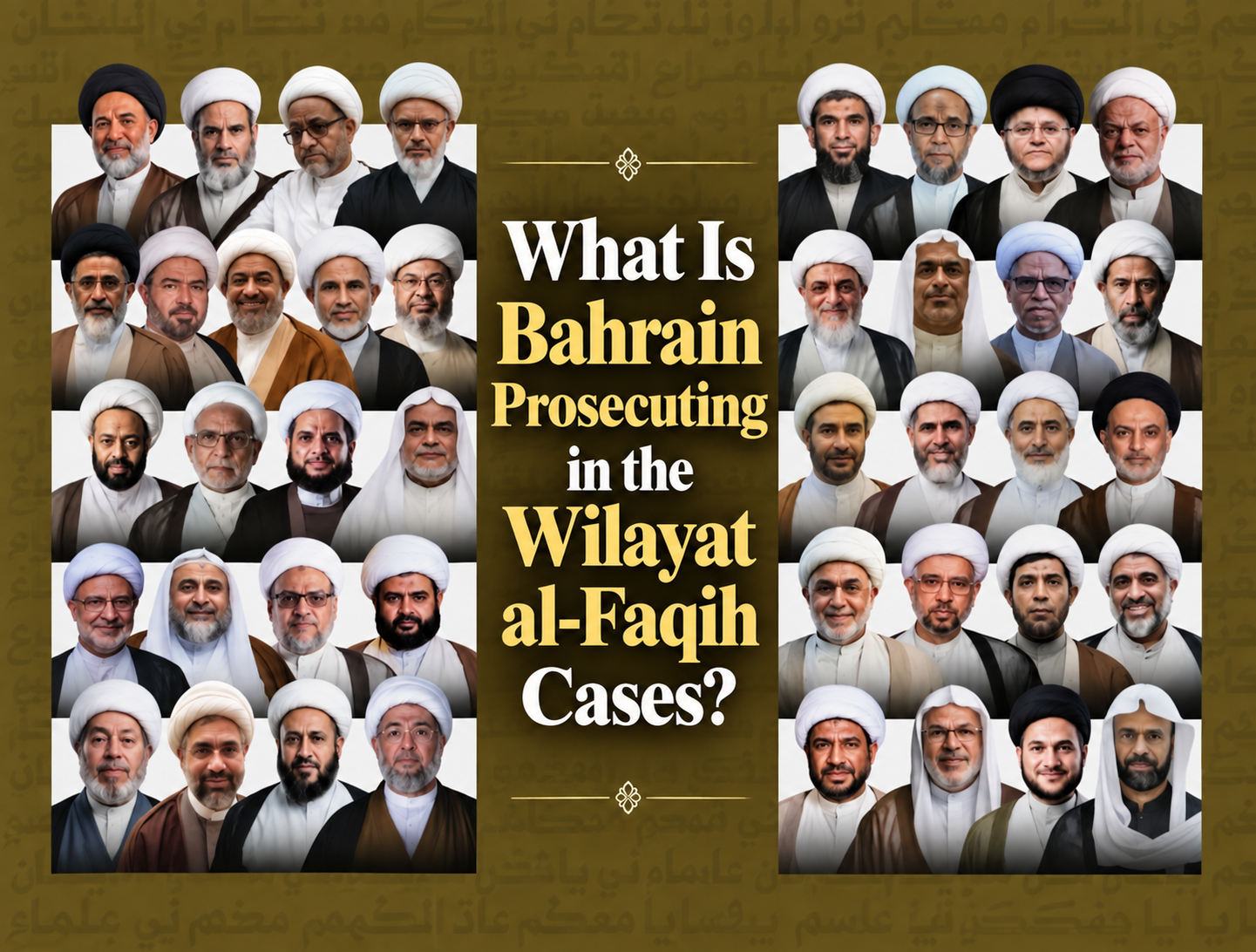
Since May 2026, the concept of Wilayat al-Faqih (Guardianship of the Islamic Jurist) has entered Bahrain’s security and judicial discourse in an unprecedented manner. The term is no longer presented merely as a religious-political doctrine whose legitimacy and scope are disputed within Shi’a jurisprudence. It has instead appeared in official statements describing it as the foundation of a political and organizational project linked to Iran and the Islamic Revolutionary Guard Corps (IRGC), before subsequently making its way into indictments and trials involving hundreds of defendants, including a large number of Shi’a clerics.
The significance of these cases extends beyond the number of defendants to a deeper question raised by the language used to characterize the offenses with which they have been charged: Where does individual accountability for a specific criminal act end, and where does accountability for a political or religious belief or doctrine begin—or become permissible?
At the outset, this question does not deny the state’s right to investigate crimes involving espionage, terrorist financing, incitement to violence, or the establishment of armed organizations that use force. These are acts that the state may—and indeed must—investigate whenever serious evidence exists. The problem arises when material acts or specific crimes become intertwined with phrases such as “spreading and entrenching the ideology of Wilayat al-Faqih,” “allegiance to the Supreme Jurist,” and “entrenching ideas hostile to the system of government.” At that point, it becomes difficult to determine whether the ideology is being treated as supporting evidence of a crime, as an element of the crime itself, or as the crime itself.
From Political Discourse to a Criminal Case
The shift became clearly apparent in a speech by Interior Minister Sheikh Rashid bin Abdullah Al Khalifa on 12 May 2026, when he described Wilayat al-Faqih as a transnational political project that places the political allegiance of its adherents with Iran’s Supreme Leader. He linked it to an organization that he said had been formed by members of the dissolved Islamic Scholars Council and had ties to Iran’s Islamic Revolutionary Guard Corps. The minister also spoke of funding, recruitment and training operations, and foreign connections.
On 31 May, the Public Prosecution announced that its investigations concerned what it described as “the principal organization linked to the Iranian Revolutionary Guard and the ideology of Wilayat al-Faqih.” It accused members of the organization of seeking control over mosques, ma’atams (Shi’a religious community halls), and religious seminaries; recruiting individuals to study the doctrine of Wilayat al-Faqih in Iran and disseminate it in Bahrain; as well as collecting funds and inciting riots and terrorist acts.
The case then moved before the courts. On 5 July, the Public Prosecution announced the referral of 19 defendants—11 in custody and eight fugitives—to trial on charges of establishing and managing a terrorist group. It stated that the investigations had uncovered fundraising, espionage involving Iran and the Revolutionary Guard, and efforts to change the constitutional system through force and unlawful means. It also referred to the seizure of sums of money and “books, publications, and papers” that it said were connected to the group’s activities. On 14 and 15 July, the Public Prosecution announced two additional cases involving 15 and 17 defendants respectively, on charges related to joining a group pursuing the same objectives.
The Bahraini public was not given access to any evidence from the Public Prosecution or any security agency supporting allegations of espionage for a foreign state, financing a terrorist organization, or direct incitement to violence. The difficulty lies in the fact that prosecution statements placed alongside these alleged acts expressions such as “spreading and entrenching the ideology of Wilayat al-Faqih,” “entrenching hostile ideas,” and “studying and disseminating the doctrine of Wilayat al-Faqih.” By their nature, such activities fall within the spheres of belief and expression unless they are directly and demonstrably connected to a criminal act. Accordingly, both at their core and in their details, these trials concern matters that are fundamentally ideological and doctrinal in nature.
What Does the Law Punish?
Bahrain’s Law No. 58 of 2006 on the Protection of Society from Terrorist Acts defines terrorism by reference to the use or threat of force, or another unlawful means constituting a criminal offense, within the framework of a criminal enterprise and for the purpose of disrupting public order, endangering the security of the Kingdom or national unity, or achieving other objectives specified by law.
More importantly, Bahrain’s own judiciary has previously drawn a line between political advocacy and terrorist crime. In an earlier Court of Cassation judgment concerning the interpretation of Article 6 of the Anti-Terrorism Law, the Court held that an organization’s mere advocacy of social or constitutional change is insufficient to classify it as a terrorist organization unless the use of force, terrorism, or other unlawful means forms part of the methods on which it relies to achieve its objectives.
This principle becomes particularly important in the current cases. The relevant standard is not whether a defendant believes in Wilayat al-Faqih, opposes Bahrain’s political system, or even advocates changing it. Rather, the question is whether that person participated in an organization that uses terrorism or committed a criminalized act that can be independently proven.
Even the Anti-Terrorism Law itself, when criminalizing the promotion of terrorist acts, links punishment under Article 11 to promoting, glorifying, or encouraging acts constituting punishable terrorist activity. It also criminalizes the possession of materials of this kind with the intention of distributing them or making them available to others. This is legally distinct from criminalizing a book or political doctrine merely because of its content—including the books and research materials presented by the Public Prosecution and the Ministry of Interior as incriminating evidence.
Freedom of Belief Is Not Freedom to Commit a Crime
Article 22 of Bahrain’s Constitution guarantees freedom of conscience and describes it as “absolute.” Article 23 also guarantees freedom of opinion and expression, although subject to restrictions concerning the principles of the Islamic faith, the unity of the people, and the prevention of discord and sectarianism.
Bahrain also acceded to the International Covenant on Civil and Political Rights (ICCPR) in 2006. The Bahraini government itself has stated before the United Nations Human Rights Committee that, following its publication in the Official Gazette, the Covenant acquired the force of law and that its provisions may be invoked before domestic courts.
The Covenant draws a clear distinction between “belief” and its “manifestation.” Article 18 protects freedom of thought, conscience, and religion, and the Human Rights Committee has affirmed that the freedom to hold a belief in itself may not be restricted. The manifestation and practice of a belief, by contrast, may be subject to legal restrictions that are necessary to protect public safety, public order, or the rights of others.
The Committee’s interpretation of Article 19 goes a step further: political and religious opinions are protected, and the mere holding of an opinion may not be criminalized. Nor may a person be subjected to arrest or prosecution because of an opinion actually held or attributed to them. The expression of an opinion may be restricted on grounds including national security and public order, but only where such restrictions are prescribed by law and are necessary and proportionate to a specific threat.
International law therefore provides no immunity to anyone who uses religious doctrine as a cover for financing violence, engaging in espionage, or establishing a terrorist organization. At the same time, however, it does not permit the doctrine itself to be transformed into a criminal offense.
Prosecuting an Organization or Prosecuting a Doctrine?
These boundaries appear less clear in the discourse surrounding the current cases. The Public Prosecution’s reference to “books and publications” seized from some defendants raises questions about the evidentiary value of such materials: Do they contain instructions for carrying out crimes or organizational communications, or are they jurisprudential and political writings discussing Wilayat al-Faqih? The distinction between these two possibilities is fundamental, decisive, and beyond dispute.
Likewise, an expression such as “entrenching ideas hostile to the system of government” is highly sensitive from a legal perspective. Opposition to the political system, criticism of it, or peaceful advocacy for its reform cannot automatically be equated with advocating its violent overthrow. It is precisely here that the principle established by Bahrain’s Court of Cassation—the requirement to prove the use of terrorist means—assumes particular importance.
On the procedural side, the Public Prosecution maintains that the defendants appeared in the presence of their lawyers, that the court granted the defense additional time to review the case files, and that lawyers were authorized to visit their clients.
By contrast, the Bahrain Forum for Human Rights states that the 19 August hearing lasted more than 13 hours and that procedures relating to the examination of prosecution witnesses, communication with lawyers, and access to evidence raise concerns regarding fair-trial guarantees. According to the Forum, the cases were subsequently divided among hearings held on 30 and 31 August and 1 and 2 September.
These are human rights allegations that require independent investigation and are not, in themselves, sufficient to determine whether the proceedings are valid or invalid. International standards are nevertheless clear that a defendant in a criminal case must be provided with adequate time and facilities to prepare a defense, that the defense must have access to the evidence being used against the accused, and that the defendant must have a genuine opportunity to challenge prosecution witnesses.
The Real Test for the Judiciary
The nature of these cases will ultimately be determined not by how “Wilayat al-Faqih” is characterized in political statements, but by the evidence on which the court relies to convict each individual defendant.
If the prosecution proves the existence of funds allocated to a terrorist organization, communications or instructions from the Revolutionary Guard, specific incitement to acts of violence, or knowing participation in an organizational structure that uses terrorism, then the cases will, at their core, concern criminal acts, regardless of the doctrine embraced by those involved.
If, however, studying Wilayat al-Faqih, adopting it as a jurisprudential doctrine, advocating it, or opposing the political system become, in themselves, evidence of membership in a terrorist organization, Bahrain will be confronting a different and more dangerous shift: a transition from criminalizing conduct to criminalizing the idea believed to lie behind it.
This is the most important test in the ongoing trials. The state has every right to protect its security from foreign-linked organizations and political violence. At the same time, however, it is required to prove criminal conduct through evidence of individual wrongdoing—not through sectarian identity or ideological affiliation.
Between these two principles lies the line that separates the rule of law from the prosecution of beliefs.