Between Appeals and Praise: Where Does Bahrain’s Press Stand on Criticism of the State?
Bahrain Press Association | October 15, 2026 | London, United Kingdom
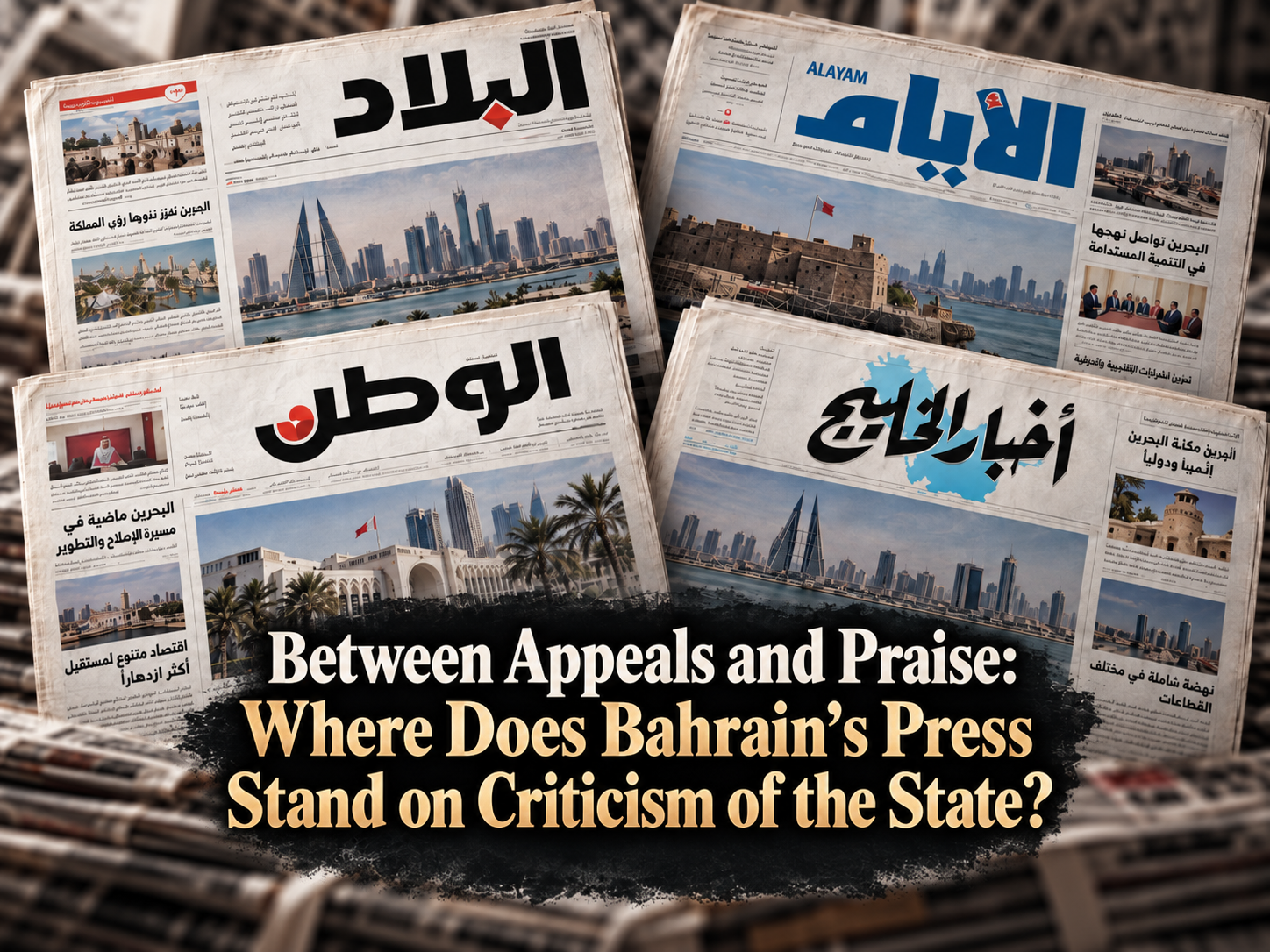
An examination of the October 15, 2026 editions of four Bahraini newspapers—Akhbar Al Khaleej, Al Ayam, Al Bilad, and Al Watan—revealed a striking contrast between the coverage of public service issues and the complete absence of direct political criticism.
Only six articles could be classified as containing explicit or implicit criticism of state policies or public services. Five addressed public services and social protection issues, while one revisited shortcomings in government institutions during an earlier period. Not a single article criticized state policies, addressed political rights from a critical perspective, or scrutinized the performance of executive or legislative institutions through the lens of political accountability.
Although these findings are based on a single edition of each newspaper and cannot be taken as a comprehensive assessment of their overall coverage, they provide an indicator worthy of closer examination. When public service complaints constitute the most visible space for criticism, while political accountability and independent investigative reporting are entirely absent, the press’s watchdog role becomes restricted, and its ability to facilitate dialogue between society and state institutions is weakened.
Findings Across the Four Newspapers
In Akhbar Al Khaleej, two articles were identified as addressing public service shortcomings. Neither constituted political criticism or direct scrutiny of the government.
The column “Electricity” (Kahraba) addressed the burden of electricity and water bills, particularly the financial pressures faced by some households, in the context of a parliamentary proposal to restore previous utility tariffs. The article framed the issue as a public demand while highlighting efforts by the legislative and executive authorities to address it, rather than directly holding the government responsible.
Another column, “A Fund for Athletes” (Sanduq lil-Riyadiyyin), by Ali Al Basha, drew attention to athletes who fall outside government or private insurance coverage. It noted that some sports federations and clubs lack the financial resources to provide adequate protection, leaving injured athletes to cover their medical expenses themselves. The writer called for the establishment of a fund offering medical and financial support.
In Al Ayam, four relevant articles were identified: three concerning public services and one referring to past government shortcomings.
In the newspaper’s Al Multaqa section, which functions much like a readers’ letters page, a retired Ministry of Education employee appealed for employment opportunities for his three university-educated daughters after years of unsuccessful job searches. In the same section, parents of secondary school students enrolled in the home-study examination system called for a third examination sitting for students who had been unable to meet graduation requirements because of medical circumstances or other factors beyond their control.
Both articles conveyed direct appeals to the relevant authorities. However, they remained individual submissions rather than investigative reports examining the scale of the problems or the reasons for their persistence.
In her article “When Life Grows Longer… Life Expands” (Hina Yatul Al-Umr… Tattasi Al-Hayat), Wajeeha Al Meer called for healthcare, social services, housing, and transportation systems to be adapted to the needs of older people, while ensuring their continued participation and independence. The opinion piece advocated improvements in policies and services without making specific accusations against the government.
The fourth article, “A Voice and a Law! When Victims Finally Had…” (Sawt wa Qanun! Hina Asbaha lil-Dahaya), revisited human trafficking cases encountered by the author in the early 2000s. It recalled a period when victims had no specialized shelters, referral mechanisms, or dedicated legislation to combat human trafficking.
This testimony documents earlier institutional shortcomings, but presents them as a phase Bahrain subsequently overcame through the establishment of new institutions and legislation. It would therefore be inaccurate to characterize the article as direct criticism of current policies. Rather, it recalls past deficiencies within a narrative emphasizing subsequent progress.
In Al Bilad, no articles were identified as criticizing the state or government performance under any of the three categories examined.
However, the opinion section included an article by Murtadha bin Hassan titled “The Phenomenon of Demonizing the State and National Achievements.” The author criticized what he described as attempts to distort and cast doubt on official achievements.
Rather than criticizing the state, the article represented a discourse directed against criticism itself, portraying certain objections to government projects and achievements as attempts to “demonize” the state.
This represents the author’s position and should not be attributed to the newspaper as an editorial stance. Nevertheless, it is significant for understanding the language surrounding criticism in Bahrain’s public sphere.
In Al Watan, no articles directly criticizing the state were identified.
The edition included an opinion piece by Haifa Adwan titled “His Royal Highness the Crown Prince and Prime Minister… Care That Touches Citizens’ Lives.” The article discussed disparities in electricity and water bills and the resulting pressure on household budgets.
However, it presented the decision to allow retroactive registration in the fixed-billing system as a government response intended to ease that burden. While acknowledging a cost-of-living problem, the article did not investigate its causes or evaluate utility pricing policies. Instead, it focused on the official measure introduced to address the issue.
Overall, the six articles counted in the assessment fell into two categories: five concerned public services or individual appeals, and one retrospectively addressed earlier government shortcomings rather than current government performance. No articles were classified as political criticism.
Articles reporting official decisions, parliamentary proposals, or government plans were not counted as criticism unless they included clear scrutiny or directly attributed shortcomings to state institutions.
From Watchdog to Messenger of Public Appeals
The findings, both in terms of the number and nature of the articles published, shed light on the forms of criticism available in Bahrain and their limitations.
The most visible public concerns appeared in readers’ letters and a very limited number of opinion columns. Yet conveying a complaint is not equivalent to holding the responsible authority accountable.
None of the articles examined followed up on whether ministries had responded to public appeals. Nor did they investigate recruitment criteria, the causes of students’ academic difficulties, the distribution of utility costs, or gaps in insurance coverage.
When journalistic coverage ends with presenting a request, the press functions more like a mailbox for public appeals than an institution that investigates the causes of problems and demands explanations or measurable solutions.
This is where the significance and potential implications of these findings become apparent.
The press loses its watchdog function when it fails to move beyond reporting facts and statements toward verification, comparison, and accountability. It also begins to lose its role as an intermediary between the state and society when it fails to transform individual grievances into matters of public concern, follow up on institutional responses, or facilitate debate incorporating multiple perspectives.
Such a contraction risks leaving the public sphere divided between an official discourse celebrating achievements and individual complaints that lack a clear path toward escalation or resolution.
The article “The Phenomenon of Demonizing the State and National Achievements” deserves particular attention in this context.
Distinguishing legitimate, evidence-based criticism from unfounded allegations is essential to any meaningful public debate. However, characterizing criticism from the outset as “demonization” or hostility toward the state narrows the space for holding policies accountable, particularly when objections are not evaluated according to their substance and supporting evidence.
A strong state does not need to shield its decisions from criticism, and professional journalism should not equate dissent with hostility. Instead, it should subject both government positions and their critics to scrutiny based on facts.
Nevertheless, editions from a single day are insufficient to establish that Bahrain’s press has completely lost its watchdog function or to measure the broader editorial trends of all newspapers.
What can reasonably be concluded is that these editions reveal a conspicuous absence of political criticism and scrutiny of current government performance, alongside a limited presence of criticism concerning public services, largely expressed through appeals and proposals.
If this pattern is confirmed through broader monitoring covering longer periods, additional publications, and a wider range of topics, it would provide stronger evidence of declining journalistic oversight and the erosion of the press’s intermediary role in connecting society’s concerns with state institutions and demanding effective responses.
Just over a decade ago, this contraction was not nearly as pronounced.
In the years following the reforms of 2001, the range of issues covered by the Bahraini press expanded, and journalism emerged as an active national participant in public debate and an intermediary conveying society’s concerns to state institutions.
Coverage of sensitive issues—from land allocation and environmental concerns to political opposition—was a regular feature of the daily press, helping establish newspapers as platforms for pluralism and public discussion.
Today, however, the erosion of this role threatens to transform the press from a watchdog overseeing public affairs and a bridge between society and the state into a conduit for official statements and individual appeals, without meaningful follow-up or accountability.
This represents a serious dysfunction affecting a vital national channel for accountability and communication. One of its consequences is the widening distance between the state and society as the press retreats from fulfilling its essential role.
Reference:
Al-Ayam Newspaper PDF edition Oct.15.2026
Al-Watan Newspaper PDF edition Oct.15.2026