Bahrain Press Association: Life Sentences Against Dozens of Shia Clerics Threaten the Future of National Coexistence in Bahrain
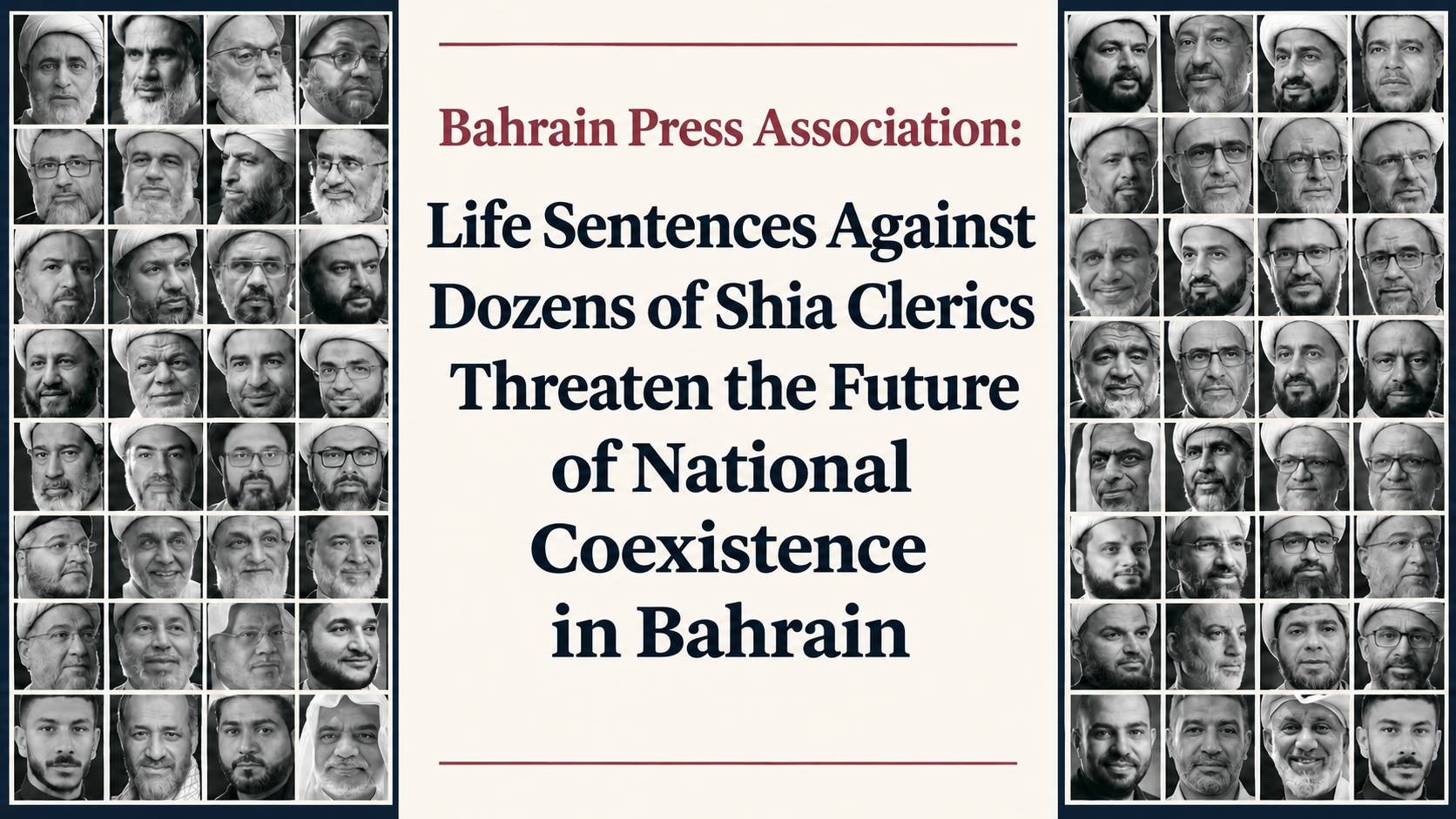
Bahrain Press Association | Monday, 16 November 2026: The Bahrain Press Association (BPA) strongly condemns the sentences handed down today by Bahrain’s First High Criminal Court, imposing life imprisonment on 64 defendants and 15-year prison terms on five others. The mass trial involved 69 individuals, including 60 Shia clerics and nine individuals working in or associated with religious affairs.
The Association believes that one of the most serious consequences of this case is the widening divide between the state and its Shia citizens, alongside the erosion of trust in institutions that are expected to guarantee their protection and equality before the law. It warns that the continuation of this approach will deepen divisions and exacerbate national and sectarian polarisation in the country.
The BPA notes that the case presents a striking contradiction that warrants serious judicial and public scrutiny. Among those sentenced are religious clerics whose public records, positions and sermons have been characterised by the rejection of violence and calls for peaceful engagement, dialogue and national reconciliation. They include Sheikh Isa Qassim, Sheikh Mohammed Sanqour, Sheikh Mahmoud Al-Aali, Sheikh Ali Al-Sadadi and others.
The documented public positions and statements of the convicted clerics raise legitimate questions about the evidence underpinning allegations of membership in a terrorist organisation and incitement to violence. The Association emphasises that the intellectual record and public statements of any defendant deserve objective examination alongside the evidence as a whole. Serious criminal charges require proof of specific acts and clearly established individual responsibility, together with full guarantees of the right to challenge and contest the evidence presented.
The BPA affirms that freedom of expression encompasses the right to hold, discuss and disseminate religious and political ideas, including those that diverge from the authorities’ policies or conflict with their positions. Sectarian beliefs, religious affiliations and ordinary religious practices must not be treated as evidence of terrorist offences without independent evidence establishing specific criminal conduct.
The BPA further notes that these concerns are heightened by serious allegations documented by local and international human rights organisations concerning the torture and ill-treatment of convicted clerics, the extraction of confessions under duress, and the signing of interrogation records that those concerned allegedly had neither been permitted to review nor participated in answering the questions recorded therein. These allegations also include restrictions on defence lawyers’ access to case files and restrictions on public access to the trial proceedings. Such allegations warrant an independent and transparent investigation, particularly given the exceptional severity of the sentences and their consequences for those convicted and their families.
The BPA recognises that protecting national security and addressing genuine threats to the country’s safety are legitimate responsibilities of the state. It also acknowledges that the seriousness of current regional threats demands the highest standards of legal and institutional discipline. Addressing foreign interference requires a careful distinction between conduct proven to constitute criminal offences and religious beliefs, affiliations and peaceful activities protected by law. The Association warns that extending suspicion to broad sections of the religious and community leadership risks weakening voices that have, over many years, advocated restraint, non-violence and the preservation of social peace.
The BPA is concerned that these sentences may become further grievances embedded in the country’s political and social memory, casting a long shadow over prospects for reconciliation and stability.
The BPA also stresses that transparency in cases with far-reaching political and religious implications is an essential safeguard for defendants’ rights, the public’s right to information and the credibility of judicial institutions themselves.
In this context, the Bahrain Press Association calls on the Bahraini authorities to take urgent measures, including:
- Ensuring an independent and effective judicial review of the sentences, with those convicted afforded the full opportunity to exercise their rights of appeal and defence.
- Making the reasoned judgments and supporting evidence available for scrutiny, enabling an assessment of the specific acts attributed to each defendant and the legal basis for each conviction.
- Initiating an independent investigation into all allegations of torture, coercion and ill-treatment, and excluding any confessions found to have been obtained through unlawful means.
- Ending the prosecution of individuals for the peaceful expression of their beliefs and opinions, and releasing anyone whose detention is found to be based solely on the exercise of their fundamental rights.
- Guaranteeing the freedom of journalists, media organisations and human rights organisations to report on the case, discuss the judgments and criticise them, while protecting defence lawyers and defendants’ families from any retaliatory measures arising from their statements or positions.
In concluding its statement, the BPA emphasises that this case represents a significant test of Bahrain’s institutions and their ability to uphold justice amid exceptional political and regional circumstances. Sentences involving such a substantial number of religious and community figures raise serious questions about the proceedings and the evidence on which they were based, and warrant a responsible review commensurate with their gravity.
The most serious consequences of these sentences will be felt across Bahraini society as a whole, given their far-reaching implications for public trust, national coexistence and the future relationship between the state and its citizens.