Bahrain in Wartime: 844 Arrests and Growing Concerns over Rights and National Cohesion
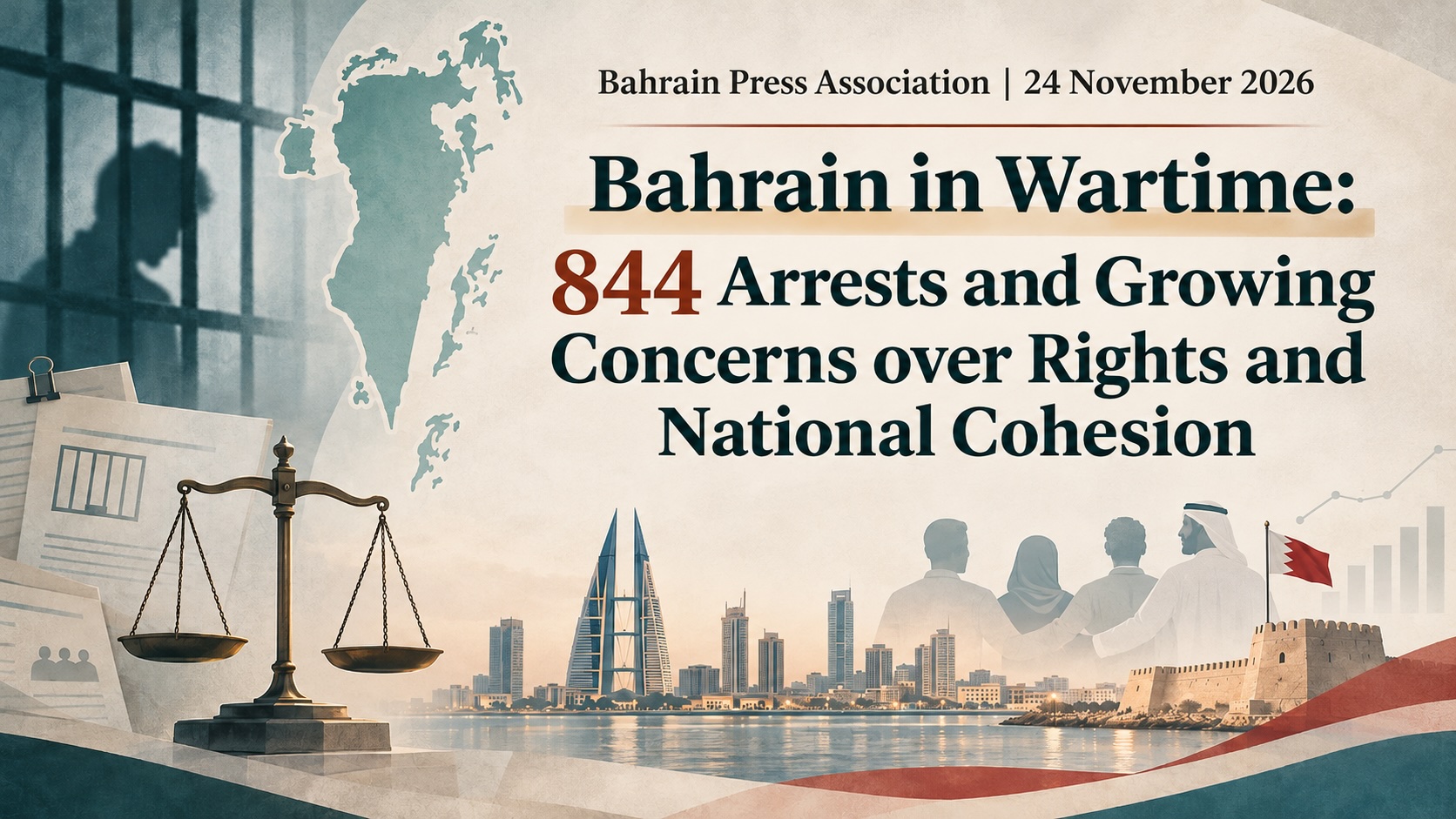
Bahrain Press Association | 24 November 2026: The latest statistics on arrest campaigns in Bahrain reveal concerning security and human rights developments. Since the outbreak of the US-Israeli war against Iran on 28 February 2026, and the subsequent Iranian attacks targeting Bahrain and other Gulf states, figures indicate an unprecedented expansion this year in the scale of arrests and security prosecutions, amid growing questions about the legal grounds for these measures and the extent to which they comply with the guarantees of justice and citizens’ rights.
According to data documented by the Bahrain Press Association from the beginning of March through 16 November 2026, a total of 844 individuals were arrested, including 834 men and 10 women. Of these, 524 remain in custody, including 357 detainees and 163 convicted individuals, alongside four cases that may be classified as enforced disappearances. Meanwhile, 312 individuals have been released, with one death in custody, cases of deportation from the country, and six cases in which the fate of the individuals concerned remains unknown.
The statistics indicate that 18 children were among those arrested, ten of whom remain in detention. Of those currently detained, 516 are Bahraini nationals and eight are non-Bahraini nationals, according to the classification provided in the Association’s data.
The significance of these figures stems from the scale of the arrests and the continued detention of hundreds of individuals for months, at a time when the grounds for the arrest of all those affected by these campaigns, as well as the nature of the evidence and legal proceedings undertaken in each case, have not been sufficiently clarified.
The killing of Bahraini citizen Mohammed Al-Mousawi while in custody in March 2026 stands out as one of the most serious incidents associated with the arrest campaigns. This was followed in June 2026 by a court ruling sentencing a member of the intelligence agency to life imprisonment, raising serious questions about the safety of detainees, the responsibility of security institutions to protect them, and the effectiveness of oversight and accountability mechanisms.
Mass Sentences Deepen the Crisis
The crisis witnessed a particularly sensitive development on 16 November, when the High Criminal Court sentenced 64 defendants to life imprisonment and five others to 15 years in prison, in a mass trial involving 69 individuals, including 60 Shia clerics, among them some of the country’s most prominent religious and social figures.
While Bahrain’s Public Prosecution maintains that the case concerns the establishment and management of a terrorist group linked to Iran’s Islamic Revolutionary Guard Corps, efforts to change the system of government, and the collection of funds to finance unlawful activities, it also asserts that the investigation and trial proceedings were based on security and financial evidence and that the defendants were afforded the legal guarantees to which they were entitled.
Nevertheless, 21 international and regional human rights organisations, including Amnesty International and Human Rights Watch, expressed serious concerns regarding the trial proceedings, citing testimonies and allegations of torture, coerced confessions, incommunicado detention, and restrictions on lawyers’ ability to access case files and prepare their defence. These allegations warrant an independent and transparent investigation to establish the facts and determine responsibility.
The political and social repercussions of these sentences extend beyond the individuals concerned. The presence of such a large number of senior Shia clerics among those handed severe sentences raises concerns about a widening divide between the state and a segment of its citizens, adding another factor to the sectarian and political tensions that Bahrain has experienced for years, particularly given that these trials were preceded by government measures affecting Shia institutions and religious endowments in Bahrain.
The widening of this divide poses a direct challenge to national cohesion, particularly as perceptions grow among segments of society that their religious identity, institutions, and leading religious figures have become targets of security measures.
National Security and Human Rights Guarantees
Bahrain faces exceptional security circumstances imposed by the regional war and the repeated and ongoing Iranian attacks against its territory and facilities. It is both the right of the state and one of its fundamental responsibilities to take the necessary measures to protect the population and critical infrastructure, and to counter espionage, incitement to violence, or any acts that threaten the country’s safety. However, the legitimacy of security objectives remains contingent upon the legitimacy of the means employed to achieve them. Protecting national security also requires respect for the principle of proportionality, a clear legal basis for arrests, and guarantees of detainees’ rights to contact their lawyers and families, appear before an independent judiciary, and receive fair trials.
These guarantees are particularly important in light of human rights reports documenting the arrest of individuals over social media posts, the expression of political views on the war, or participation in peaceful gatherings. It is essential to distinguish, in each case, between acts that constitute a genuine security threat and activities protected by the freedoms of opinion, expression, peaceful assembly, and religious belief.
Citizenship revocation measures raise additional and particularly grave concerns. On 27 April 2026, the Bahraini authorities announced the revocation of citizenship of 69 individuals over allegations of expressing sympathy with Iranian attacks or communicating with foreign entities. Human rights organisations criticised the decision, particularly its impact on family members and children, and the possibility of rendering individuals stateless. The subsequent deportation orders against these individuals also came as a shock to their families and relatives.
The Association stresses that citizenship constitutes a fundamental legal bond between citizens and their state, and that any interference with this bond requires stringent safeguards against arbitrariness and discrimination, as well as access to effective judicial review. Political or sectarian differences should not become grounds for depriving individuals of the rights upon which equal citizenship is founded.
Concerns over Deepening Internal Divisions
These developments raise questions that extend beyond the legal fate of detainees and prisoners to the future of relations between the state and society. The continuation of widespread arrests, the accumulation of severe judicial sentences, and the uncertainty surrounding the fate of some detainees are all factors that may heighten anxiety and deepen mistrust in state institutions.
These risks become more acute in Bahraini society, which has a long history of political divisions and sectarian tensions, particularly amid a growing perception among segments of the Shia community that security prosecutions are targeting their religious institutions and prominent social figures.
This underscores the state’s responsibility to safeguard civil peace, ensure equality among citizens, and prevent religious affiliations or political positions from being used as indicators of national loyalty or grounds for accusation.
The repercussions of the regional war place Bahrain before a highly sensitive political and human rights test. Addressing this challenge requires reviewing the circumstances of detainees, disclosing the fate of those from whom no news has been received, ensuring the integrity of judicial proceedings, conducting independent investigations into allegations of torture and ill-treatment, and releasing all those whose detention is found to have resulted from the peaceful exercise of their fundamental rights.
The most important question remains whether Bahrain can protect its national security without doing so at a heavy cost to its citizens’ rights and their trust in the state. Security measures adopted by states during wartime may leave political and social repercussions that persist for many years after conflicts have ended. Containing these repercussions becomes increasingly difficult as citizens’ grievances grow and opportunities to address them through justice and dialogue diminish.